BRONZE
Characterised by exquisite craftsmanship and attention to detail, Maysaloun Faraj’s captivating bronze sculptures explore themes of identity, cultural heritage and Islamic faith. Each piece is meticulously crafted to capture the essence of her subject matter; a reflection on her personal experience and the wider-reaching worldly affairs. Her most iconic bronze works are from a series inspired by Hurouf al-I’jaz (Miracle Letters); mystical letter combinations prefixing 29 Suras in the holy Qur’an with inherent aesthetic and spiritual principles.

2012 I’jaz (Meem Hha Ain Seen Qaaf) • 155cm (h).
Sculpture by Maysaloun Faraj acts a springboard into a language without words. Her pieces are delicate and lyrical - silent letters in a lifelong correspondence with the divine. They incite profound reflection on the endless possibilities of matter in relation to the universe, as well as embodying the artist’s unstoppable sincerity, which passes fervently through sinuous twists of bronze before settling more restfully in slender tablets of clay.
There is a ripe and startling physicality to the sculpture even though on the surface each is fragile, fragmented and often executing an impossible balancing act: Golden Bird (2008) features fragments of white earth-stone carefully arranged one upon the other and exquisitely tipped with gold as if a seal to a sacred scroll. I’jaz (2012) presents a thin column of bronze that weaves its way skywards, stretching almost to breaking point but never once toppling. In its endurance, the riddling structure resembles a calligraphic dance, rising in a swaying path towards the void in the heat of risk, ecstasy and triumph.
The innocence and magnificent naivety that ebbs from the sculpture comes directly from its continual aspiration towards simplicity. There is a feeling that the artist is constantly sifting and extracting any distraction to her work’s essence so that each line, each hue, is entirely a product of necessity. She compulsively puts her materials to the test, intensely working them in such a way that sees her master her own hand, erasing any obvious signs of human intervention and forging pieces that appear deliciously untouched, but arranged with great skill.

2010 Al-Rahman Al-Rahim • 145cm (h) Bronze.
It is striking that both the fired earth-stone and the cooled bronze consistently manage to retain their soft suppleness while bearing force in their crisp lines as well as in the slow, strong bends of the material. Even though the shapes making up each sculpture tend to assume their own mysterious order, the unusual harmony of line and colour invariably points at a sense of wholeness, of plenitude. And the balance of elements, though at times in apparent defiance of gravity, is all the more marked for its successful amalgamation of apparently discordant parts. One particularly recurrent motif - the thin white crescent resting atop a block of clay - hints once again at the universal nature of Faraj’s approach, her referencing of works by a generation of Iraqi artists before her, including Jewad Selim, and much further back in time, to the symbols as well as techniques explored in the visual cultures of Ancient Mesopotamia and Egypt.
As a whole, the artist’s oeuvre reveals a vision that is luminous and progressive. Each sculpture offers a distinct sensation of oneness dissolving, transforming then redefining itself, first into clay, now most recently bronze, in an ongoing act of material purification. As a series, they tell wordless stories of how the brokenness of things is in fact the necessary beginning of a journey towards greatness, with former wounds evolving into sacred scars, testifying to a life fully lived, and within that - a verve, a glimpse of the divine”. By Kate Busby, Barcelona 2012
Kate Busby is an alumnus of Oxford University and a freelance writer. She has worked with Milton Keynes Gallery, Edge of Arabia, JAMM Art and regularly publishes articles on contemporary art. She currently lives and works in Barcelona where she is a co-curator at the Madame La Marquise art space.

2010 Dham’ma Allah Noor • 45x45x9cm.

2010 Tomorrow My Heart Will Heal: Al-Mu'min Al-Mu'eed • 30cm (h) Bronze.
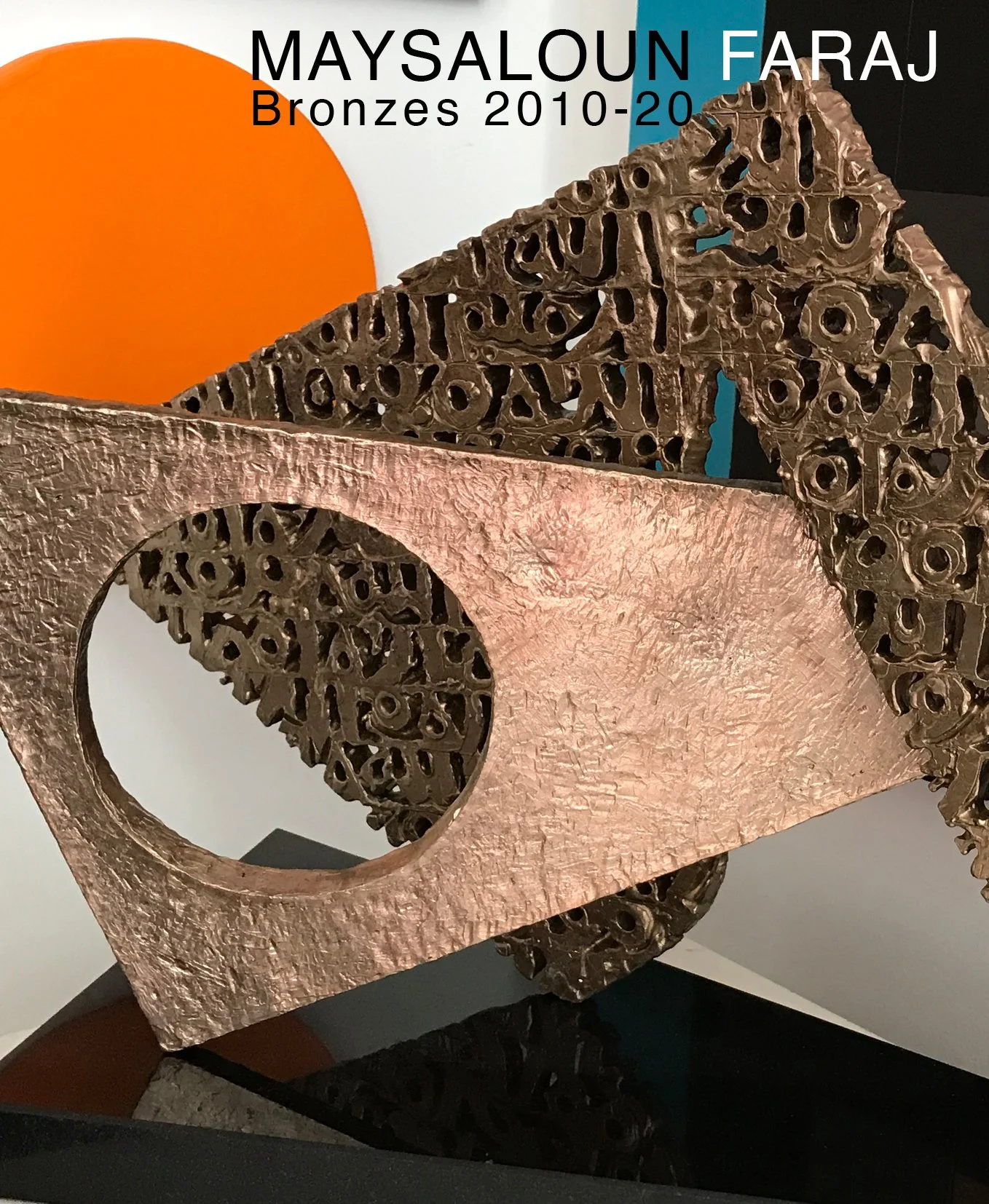
Further Bronze works by Maysaloun Faraj can be viewed in this catalogue.
“The enigmatic nature of the letters, together with my fascination with Arabic typography and etymology, drives my desire to reveal the Sacred in the everyday. Within carefully considered constructs, the letters evoke the infinite magnitude and hidden energy of the world around us. Inspired by the geometric potential of the Arabic alphabet, my visual vocabulary is distilled to basic shapes, squares, triangles and circles, creating an ideal space for harmony and order. The I’jaz series reflects my longing for a healed, balanced world to overcome the senseless destruction that continues to afflict our time.
I hope my work stands as a testament to the power of art to connect people across cultures and eras, to illuminate pressing issues, and to contribute meaningfully to contemporary art while celebrating the enduring cultural heritage of Iraq and the Middle East.”